
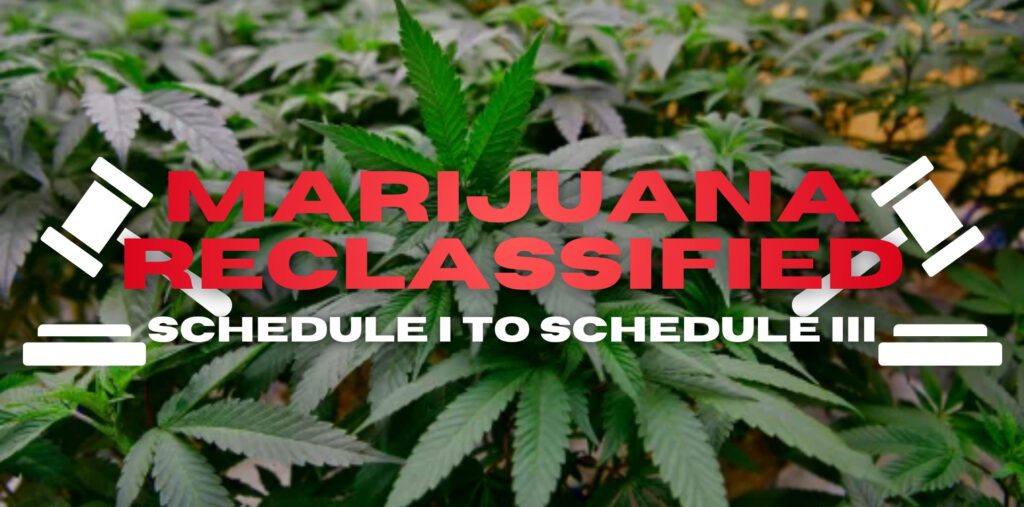
The cannabis industry has entered a new phase. In 2026, the U.S. Department of Justice formally moved certain marijuana products—particularly FDA-approved and state-regulated medical cannabis—from Schedule I to Schedule III under the Controlled Substances Act. This marks one of the most significant federal policy shifts in decades and signals a broader change in how cannabis is viewed at the national level.
What This Change Actually Means
Cannabis is not federally legal after this change, and recreational use remains prohibited under federal law. However, the shift from Schedule I to Schedule III is still highly significant. Schedule I drugs are defined as having no accepted medical use and a high potential for abuse, while Schedule III substances are recognized for having legitimate medical applications with moderate to low abuse potential.
That reclassification alone reshapes the narrative. The federal government is now formally acknowledging that cannabis has medical value, which helps legitimize its role in treatment and wellness. While it doesn’t eliminate federal restrictions, it reduces the severity of how cannabis is treated and opens the door for broader reform in the future.
A Major Shift in Taxation for Dispensaries
One of the most immediate impacts of this change is financial. Under its previous Schedule I status, cannabis businesses were subject to IRS Section 280E, which prevented them from deducting standard business expenses. This created a heavy tax burden that significantly reduced profitability across the industry.
With the move to Schedule III, that restriction is expected to ease for qualifying operators. Dispensaries may now be able to deduct expenses like rent, payroll, and operational costs, similar to other businesses. This shift has the potential to dramatically improve margins and free up capital for reinvestment, growth, and better customer experiences.
Research and Medical Development Will Expand
Another major outcome of rescheduling is the expansion of cannabis research. Schedule I classification made it extremely difficult for researchers to study cannabis due to strict regulatory barriers. Now, those barriers are expected to loosen.
This opens the door for universities, medical institutions, and pharmaceutical companies to conduct more clinical studies and develop cannabis-based treatments. Over time, this could lead to more standardized products, improved dosing guidelines, and greater confidence from healthcare providers. The long-term effect is a more scientifically grounded cannabis industry.
Federal and State Laws Are Moving Closer—But Not Fully Aligned
For years, state and federal cannabis laws have been out of sync. Most states allow medical marijuana, and many have legalized recreational use, while federal law has remained far more restrictive.
Moving cannabis to Schedule III helps narrow that gap, but it does not eliminate it. Dispensaries still operate under state regulations, and federal limitations around banking, interstate commerce, and compliance remain in place. The industry is closer to alignment than before, but there is still a fragmented legal landscape to navigate.
How This Affects Dispensaries Like Scarlet Reserve
1. Stronger Financial Position
Lower tax burdens mean dispensaries can:
- Reinvest into inventory and product quality
- Improve customer experience
- Expand operations more sustainably
This shift could separate well-run dispensaries from struggling ones very quickly.
2. Increased Competition
As federal pressure eases, expect:
- More investors entering the cannabis space
- Expansion of multi-state operators
- Growth in medical cannabis programs
Dispensaries will need to differentiate through branding, product quality, and education—not just availability.
3. Operational Complexity Isn’t Going Away
Even with Schedule III:
- Federal compliance requirements (like DEA registration and recordkeeping) may increase
- State-by-state rules still apply
- Recreational cannabis businesses may not benefit immediately
So while taxes may improve, compliance could become more sophisticated.
4. Banking and Legalization Still in Limbo
Many people assume this change fixes everything—it doesn’t.
Key issues still unresolved:
- Limited access to traditional banking
- No federal legalization of recreational cannabis
- Interstate sales still restricted
In short: this is a step forward, not the finish line.
The Bigger Picture: A Turning Point, Not the Endgame
The move from Schedule I to Schedule III represents the most meaningful federal cannabis reform in over 50 years.
It validates what dispensaries, patients, and advocates have been saying for decades:
Cannabis has real medical value.
But the industry is now entering a new phase—one that’s more regulated, more competitive, and more closely tied to traditional healthcare and pharmaceutical frameworks.
What This Means for Scarlet Reserve Customers
For our community, this shift means:
- Continued access to high-quality cannabis products
- Potential for better pricing as tax burdens ease
- More innovation in medical-grade cannabis products
At Scarlet Reserve, we’re watching these changes closely and adapting in real time—so we can continue delivering premium products while staying ahead of the evolving regulatory landscape.
📍 Final Thoughts
Rescheduling marijuana to Schedule III doesn’t legalize cannabis—but it legitimizes the industry in a way we’ve never seen before.
For dispensaries, it opens the door to:
- Financial stability
- Scientific advancement
- Long-term industry growth
For consumers, it signals something just as important:
Cannabis is no longer being treated like the most dangerous drugs in the country—and that changes everything.